At Depannage Lybaert there are always towed vehicles standing in the yard, and the inventory was kept by hand in a spreadsheet. Now you take a photo of the car in the yard, AI reads the plate and the chassis number, and the file fills itself in. With a map that tells you which numbered spot the car is on.

Depannage Lybaert tows and stores. Their yard in Ghent always holds vehicles: breakdowns, seized cars, vehicles waiting for transport. They come and go, and in between someone has to know what is there, who owns it, and where exactly.
The starting point
That inventory lived in a spreadsheet, kept by hand. A car coming in meant typing a row: plate, chassis, make, where it stood. A car leaving meant finding that row again. And the question “where is the one from yesterday?” often just meant walking out into the yard to look.
Nothing wrong with a spreadsheet, until it runs into the hundreds and the cars shift around every day. Then retyping gets slow and things go missing.
What we built
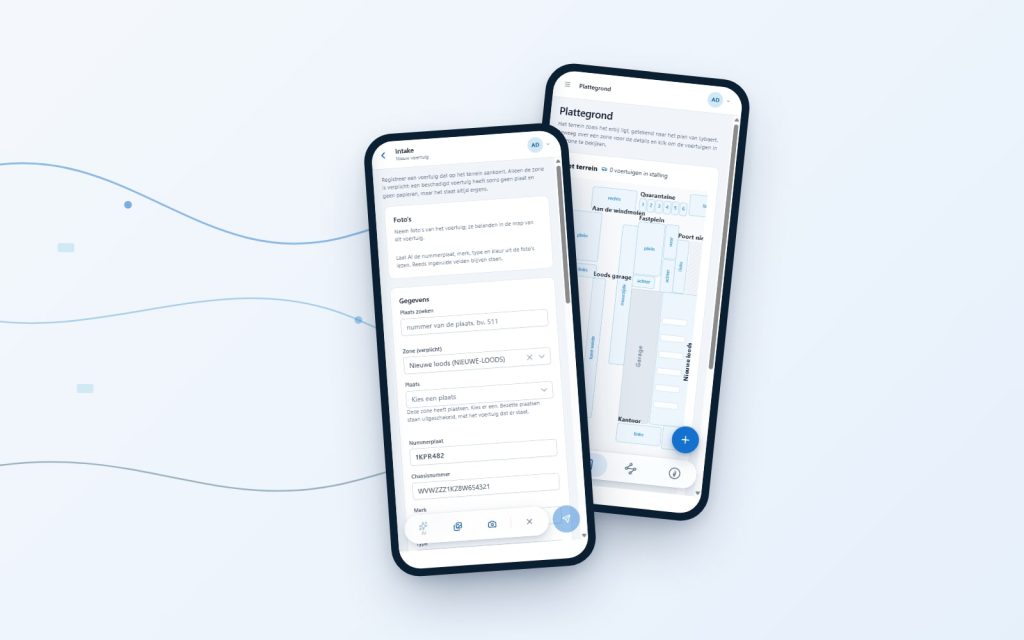
An app on the phone, part of their own platform. You stand next to the car, you take a photo of it, and AI reads the plate and the chassis number out of it. The file fills with what it recognises, you check it and pick the spot the car is on. Done in the time it used to take to boot up the laptop.
The photo does the work
The camera sits inside the app itself, so you take several photos in a row without clicking away each time. AI reads not just the plate, but the chassis number, a foreign plate, and even a chalk number written on the windscreen. If the car has no plate, it picks up that chalk code as an identifier.
And it works the other way round too. Standing in the yard, want to know which car this is? Take a photo of it, and the app finds it back in the inventory.
Every car a spot
The yard is divided into zones with numbered spots, over six hundred in all. When a car comes in you pick the spot, and the map shows you at once what is free and what is taken. One car per spot, so putting two cars in the same place simply cannot happen. When the car is released, it leaves storage and its file moves on to the history, with who brought it and when it left. The spot frees itself.
Works without a network too
A yard does not have good reception everywhere. So the app remembers what you enter and sends it through the moment there is a connection again. You notice nothing, you just keep working. And the inventory meanwhile keeps itself up to date in their own document folder, so anyone who would rather look at an overview than at the app always sees the same thing.
And you?
This pattern isn’t tied to tow trucks. A warehouse, a depot, a rental fleet, anywhere physical things come and go and someone keeps track by hand, we see the same thing: a spreadsheet running behind and half an hour spent looking for what is where. Sound familiar? Let us have a look. The first look is free and without obligation.