I use the big AI model once, while building, to write the software and its tests. After that, plain code runs every day and costs no tokens. Where a model is still needed, a small one does a single job on our own machine. What that means for cost, testing and your data.

Harper Carroll, who builds AI for a living, said something in a short video that put a name on what I'd been doing for a while: token minimizing instead of token maxing. Token maxing is when every step of an automation goes through a big model, every day, and you pay per token for work that never changes. I think that era is ending, at least for small companies.
The big model is for building
When I build an automation, I do use the biggest model I can get. I use it to think through the process, to write the software and to write the tests around it. That costs tokens, once.
After that, what runs is plain code. It validates, it saves, it sends. A plain program doesn't know what a token is, so a run costs nothing in tokens. It does the same thing on the thousandth day as on the first.
What that looks like in practice
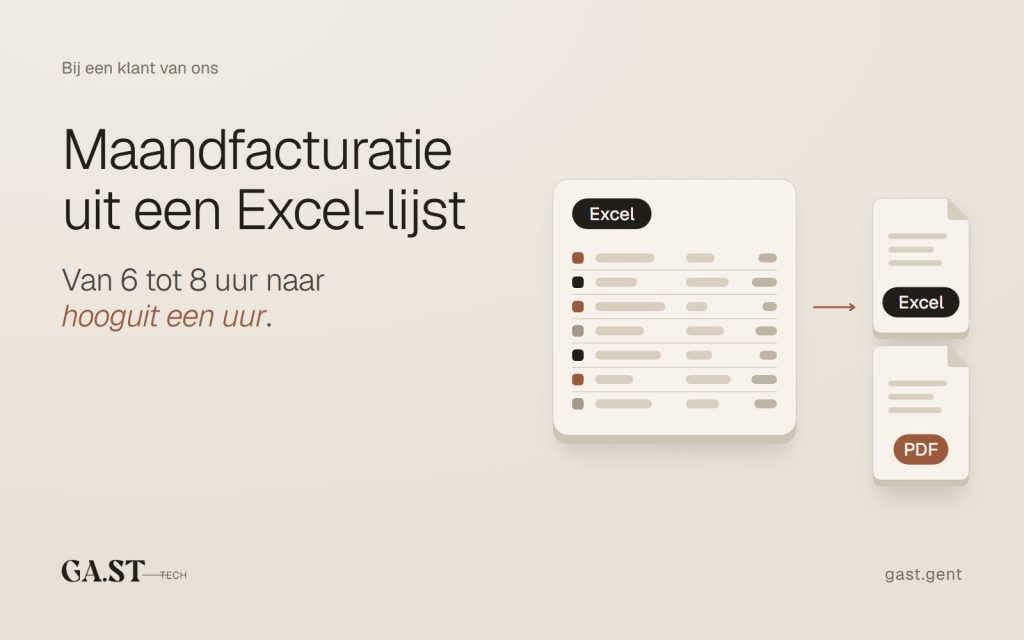
A towing company I work with used to build its monthly invoices by hand from an Excel sheet of towed vehicles. Now a module reads the sheet and makes the invoices. There's no model in that loop at all. It's code that was written once and tested, and a person checks the result before it goes out.
Same idea for a purchase-receipt chaser I run: each month it collects supplier invoices on a local box and files them. Nobody pays per run, and it doesn't wake up a language model to remember what an invoice is.
Our own cold-mail rounds work the other way around. There a model does draft, because writing a first version is exactly what it's good at. A human reads it and presses send.
Where a model still earns its place
Some input is just messy. A PDF where the layout changes per supplier, an order typed into a phone message, a mail that has to be sorted into the right pile. Code alone struggles there, so a model reads it.
Even then I use a small one, for that one task, running on our own machine. It extracts the order lines or picks the category, hands the result to code, and code does the rest. Because it runs locally, the content of those mails and PDFs doesn't leave the office.
Why this matters for a small company
Cost stays predictable. If a model runs on every step, your bill grows with your volume, and you find out when it arrives. With plain code, ten times more invoices is the same program doing ten times more of the same work.
It can be tested. Unit tests run before anything ships, and when something breaks they fail first, so the problem shows up on my screen and not in your inbox. A model can answer differently tomorrow than today. A test can't be talked into passing.
And less of your data travels. The parts that need a model run on our own machine, and the parts that don't need one never touch anything outside.
What about you?
Look at the automations you already have, or the AI tools your team runs daily. Where does a model run every day that could have been code?